The Company is committed to strengthening its hotel business to support the growth of the country’s tourism industry. This includes expanding hotel networks, offering a diverse range of hotel segments, and delivering high-quality services that provide unique experiences in prime location for tourist and economy. All operations are governed by principles of good corporate governance, with sustainable procurement and supply chain management as priorities.
The Erawan Group Public Company Limited does not make any political contributions or expenditures to political campaigns, political parties, lobbying activities, trade associations, tax-exempt entities, or any other groups whose role is to influence political campaigns, public policy, or legislation.
| Contribution | FY2022 | FY2023 | FY2024 | FY2025 |
|---|---|---|---|---|
| Lobbying, interest representation or similar | 0 | 0 | 0 | 0 |
| Local, regional or national political campaigns/ organizations/ candidates | 0 | 0 | 0 | 0 |
| Trade associations or tax-exempt groups (e.g. think tanks) | 0 | 0 | 0 | 0 |
| Other contributions and other spending (e.g. spending related to ballot measures of referendums) | 0 | 0 | 0 | 0 |
The Company remains committed to conducting business with integrity, transparency, and in compliance with all applicable laws and regulations.
Industry Engagement and Collaboration
The ERAWAN Group actively participates in industry associations, sustainability initiatives, and tourism development networks at both national and international levels. Through these engagements, the Company supports responsible tourism, business ethics, sustainable hospitality development, and continuous improvement in ESG performance.
Key Areas of Engagement
Anti-Corruption and Business Ethics
The Company participates in anti-corruption initiatives, including the Thai Private Sector Collective Action Against Corruption (CAC), to promote ethical business practices and responsible corporate conduct.
Tourism and Sustainability Development
ERAWAN engages in tourism sustainability collaboration programs and industry platforms that promote responsible tourism, sustainable hospitality, and knowledge sharing. Hotels operated under internationally recognized brands also participate in relevant hotel and tourism associations and sustainability programs in their respective markets.
Food Safety and Responsible Food & Beverage Management
The Company actively participates in hospitality and tourism industry initiatives that promote responsible food and beverage management, consumer health and safety, and sustainable hospitality practices. Through collaboration with industry associations, tourism-related organizations, hotel operators, and relevant regulatory authorities, ERAWAN supports the adoption of food safety, hygiene, and quality standards across its hotel and food service operations.
Collaboration with Hotel Brands and Food Service Operators
The ERAWAN Group works with internationally recognized hotel brands and food service operators to implement:
- Food safety management systems
- Supplier quality controls
- Responsible food handling practices
- Food hygiene and quality standards
- Compliance with applicable laws, regulations, and industry standards
These collaborative efforts support continuous improvement in food quality, customer health and safety, and responsibled food and beverage services.
Supporting Continuous Improvement
ERAWAN also participates in tourism and sustainability initiatives that promote responsible consumption, customer well-being, and sustainable hospitality development.
Through these industry engagements, the Company supports:
- Knowledge sharing and best-practice exchange
- Industry collaboration and capacity building
- Food safety and hygiene improvement
- Product and service quality enhancement
- Consumer protection and well-being
- Sustainable hospitality development
Through continued collaboration with industry stakeholders, ERAWAN seeks to strengthen responsible business practices and contribute to the long-term sustainability of the hospitality and tourism industry.
Shared Value Creation
The Company is committed to continuously strengthening its business in alignment with both national and international sustainability standards. In 2025, hotels within the Group obtained the following sustainability certifications:
Grand Hyatt Erawan Bangkok
- ASEAN Green Hotel – Sustainability Certified
- STGs STAR – 5 Stars
- HACCP & GHPs - Food Safety Management System Accredited
- ISO22000 - Food Safety Management System Accredited
- ISO14001 - Environment Management System Accredited
- ISO 20121- Certified Sustainable Event Management
- TCEB: Hygiene & Hybrid (2HY) Certified
- TCEB: TSEMS Level 3 - Leading (Thailand Sustainable Event Management Standard)
- Thailand Tourism Outstanding Award 2025 - Luxury Hotel
- Thailand Tourism Outstanding Award 2025 - Hotel and Resort Spa
- Green Key Certificate
- Trusted Thailand by Tourism Authority Thailand
JW Marriot Bangkok
- STGs STAR – 5 Stars (valid until November 2025)
- Green Leaf Sustainability Standard - 4 Leaf Level 2024-2027
- Green Health Hotel Standard/ Dept of Health: Health & Environment Friendliness 2024-2026
- Smart Travel Asia “Top 10 Best Hotels Service and Sustainable Hotels”
- Trusted Thailand by Tourism Authority Thailand
Courtyard by Marriott Bangkok
- STGs STAR – 5 Stars (valid until November 2025)
- Green Hotel Plus Award
- Thailand Sustainable Event Management Standard (TSEMS) 2025
- Trusted Thailand by Tourism Authority Thailand
The Naka Island, a Luxury Collection Resort and Spa, Phuket
- Green Leaf Sustainability Standard for Hotels
- STGs STAR – 5 Stars
- Trusted Thailand by Tourism Authority Thailand
Holiday Inn Pattaya
- STGs STAR – 5 Stars
- GREEN Health Hotel Award
- BCCT Eastern Economic Corridor International Business Awards (EECIBA) 2025 – Tourism Excellence (Runner Up)
- Trusted Thailand by Tourism Authority Thailand
Accor Hotels
- Green Key Certificate and Trusted Thailand by Tourism Authority Thailand:
- Novotel ibis Styles Bangkok Sukhumvit 4
- Mercure ibis Bangkok Sukhumvit 24
- ibis Phuket Patong
- ibis Bangkok Riverside
- ibis Bangkok Sukhumvit 4
- ibis Pattaya
- ibis Bangkok Sathorn
- Mercure ibis Bangkok Siam
- Mercure Pattaya Ocean Resort
HOP INN Thailand
- STGs STAR (45 branches)
- Outstanding Private Sector Organization Award 2025 – Accessible Facilities for Persons with Disabilities (HOP INN Songkhla Hotel) by the Songkhla Provincial Social Development and Human Security Office
Food Safety, Quality and Customer Well-being
The ERAWAN Group recognizes its responsibility to minimize potential negative impacts of food and beverage products and services on customers. The Company is committed to maintaining high standards of food quality, safety, hygiene, and customer well-being across its hotel operations in Thailand and overseas.
Our Commitment
ERAWAN works closely with internationally recognized hotel brands, restaurant operators, suppliers, and relevant authorities to ensure that food and beverage products served to guests meet applicable regulatory requirements, food safety standards, and responsible hospitality practices.
Our approach focuses on:
- Food Quality and Safety – Maintaining high standards for food quality, hygiene, and safety throughout hotel and food service operations.
- Supplier Management – Applying supplier management and quality control processes to support responsible sourcing and food safety across the value chain.
- Operational Controls – Implementing food hygiene controls, quality assurance measures, and regular operational reviews to safeguard customer health and safety.
- Regulatory Compliance – Ensuring food and beverage operations comply with applicable laws, regulations, and relevant industry standards.
Customer Information and Well-being
Beyond regulatory compliance, the Company is committed to providing customers with accurate product information, high-quality food and beverage offerings, and safe dining experiences that support informed consumer choices and overall well-being.
Customer feedback, guest satisfaction assessments, and service quality reviews are regularly monitored to identify opportunities for improvement and address potential concerns in a timely and effective manner.
Continuous Improvement
The ERAWAN Group believes that safe products, exceptional service quality, and responsible hospitality experiences create long-term value for customers and stakeholders.
Through continuous collaboration with hotel brands, suppliers, food service operators, and other relevant stakeholders, the Company strives to continuously enhance:
Food Safety
Rigorous standards and controls to protect customer health and safety.
Product Quality
Consistent quality of food and beverage products and services.
Guest Experience
Safe, comfortable, and memorable hospitality experiences throughout the guest journey.
Responsible Hospitality
Business practices that support customer well-being and sustainable tourism development
Creating Trusted Guest Experiences
Through its portfolio of hotels and partnerships with leading international hospitality brands, the ERAWAN Group strives to provide high-quality products and services that promote health, safety, comfort, and guest satisfaction.
By prioritizing customer well-being, transparency, and responsible business conduct, the Company seeks to build lasting relationships and create trusted, positive experiences for guests across its hotel network in Thailand and overseas.
Our Commitment
The ERAWAN Group is committed to managing and minimizing potential health and safety impacts associated with its food and beverage products and services. Through rigorous food quality and safety standards, responsible hospitality practices, transparency, and continuous improvement, the Company strives to create sustainable value and trusted experiences for guests throughout their journey with ERAWAN.
Responsible Food and Beverage Practices
The ERAWAN Group recognizes its responsibility to promote customer health, well-being, and responsible consumption through its food and beverage operations.
Although the Company is not a manufacturer of processed foods or beverages, it actively works to minimize potential negative impacts associated with food consumption through responsible menu development, healthier choices, stringent food quality and safety standards, and transparent customer communication.
Our Commitment
The ERAWAN Group is committed to:
- Promoting healthier and more balanced food and beverage choices
- Maintaining high standards of food quality, safety, and hygiene
- Providing transparent and accurate product information
- Supporting diverse dietary needs and lifestyle preferences
- Enhancing customer well-being and informed decision-making
- Continuously improving food and beverage offerings and guest experiences
Targeted Product and Service Development
The Company continuously reviews and enhances its food and beverage offerings to respond to evolving customer preferences, health considerations, and sustainability expectations.
Hotels across the Group collaborate with international hotel operators, chefs, nutrition-conscious culinary teams, and suppliers to develop and introduce menu options that support balanced diets and diverse dietary needs.
These may include:
- Healthier Choices: Menu options designed to support balanced and nutritious eating.
- Fresh Ingredients: Greater emphasis on fresh ingredients and quality food preparation.
- Plant-Based Options: Alternative choices that respond to growing interest in plant-based dining.
- Dietary Alternatives: Menu selections designed to accommodate diverse dietary needs and lifestyle preferences.
Promoting Responsible Consumption
The ERAWAN Group proactively offers and promotes healthier food and beverage options across its hotels and restaurants. Through menu design, promotional activities, and customer engagement initiatives, guests are provided with a range of choices that support responsible consumption while maintaining service excellence and customer choice.
The Company also seeks to provide clear and transparent product information to support informed decision-making and enable guests to select food and beverage options that best suit their individual preferences and needs.
Listening to Our Customers
Customer feedback and market insights are important to the continuous development of our food and beverage offerings.
The Company uses:
- Guest feedback mechanisms
- Customer satisfaction surveys
- Food quality assessments
- Food and beverage trend reviews
- Ongoing operational reviews
These insights help hotels identify opportunities to improve product quality, menu offerings, and overall guest experiences.
Creating Positive Guest Experiences
By integrating health, safety, quality, and customer well-being into its food and beverage operations, the ERAWAN Group strives to minimize potential negative impacts associated with food consumption while enhancing customer satisfaction.
Through responsible menu development and sustainable hospitality practices, the Company aims to create positive, trusted, and memorable dining experiences and deliver long-term value for customers and stakeholders.
Supply Chain Management
Suppliers are one of the key stakeholders of The Erawan Group. The Company is committed to fostering long-term and sustainable partnerships through fair and transparent business practices, while continuously listening to and engaging with suppliers. The Company also promotes knowledge sharing, quality improvement, and collaborative capability development to strengthen mutual growth.

To enhance effective risk management across the business value chain, the Company has established criteria for identifying critical suppliers, along with supplier screening and selection procedures, payment policies, and a Supplier Code of Conduct to promote a sustainable and responsible supply chain.
In addition, the Company places strong emphasis on supplier communication and capability development through training programs and guidance on procurement procedures, business directions, human rights principles, and technical knowledge sharing. These initiatives aim to strengthen suppliers’ operational capabilities and support alignment with the Company’s sustainability goals.
Suppliers shall monitor and seek to reduce their energy consumption and greenhouse gas (GHG) emissions, including CO2 , improve energy efficiency, and increase the use of renewable energy where feasible. Suppliers are encouraged to set emission reduction targets and, upon request, share energy and GHG emissions data with The Erawan Group PLC to support the Company's climate strategy and Scope 3 emissions assessment.
Critical-tier Suppliers Criteria
The Erawan Group has established criteria for classifying critical-tier suppliers to assess risks and efficiently manage the business supply chain into 2 categories;
1. Broken down by value
Vendors/ contractors with transaction over 3 percent of total transactions with vendors/ contractors are considered to be significant suppliers of ERW (critical 1-tier)
2. Broken down by type of services
The Company has classified its business operations into 3 sub-operations; 1) Head Office 2) Project Development and 3) suppliers of hotel properties. There are operational differences between the three sub-operations, both type of vendors/ suppliers and large differences in contract value. Therefore, the Company has set type of vendors/ suppliers according to type of services as follows:
2.1. Project Development Suppliers
2.2. Hospitality Suppliers
2.3. Operation & Assessment Suppliers
Critical Tier 1 Suppliers
Critical Tier 1 suppliers refer to suppliers that conduct business directly with The Erawan Group and are considered strategically important to the Company’s operations, products, and services. The criteria for identifying Critical Tier 1 suppliers include:
- Suppliers with high procurement value or significant business volume
- Suppliers providing products or services essential to hotel operations and business continuity
- Suppliers with potential environmental, social, human rights, or governance (ESG) risks
- Suppliers that have a direct impact on guest experience, product quality, safety, and service standards
- Suppliers with limited substitution options or high dependency risk
- Suppliers operating in industries or areas identified as high-risk by the Company
In addition, the Company has established a criterion that the Top 5 Critical Tier 1 Suppliers, based on the highest procurement spend with the Company, are required to undergo annual on-site ESG audits. These suppliers are considered highly significant to the Company due to their substantial impact on operational costs and business continuity.
Critical Non-Tier 1 Suppliers
Critical Non-Tier 1 suppliers refer to upstream suppliers or business partners that do not directly conduct business with the Company but may have significant impacts on the Company’s value chain and sustainability performance. The criteria for identifying Critical Non-Tier 1 suppliers include:
- Suppliers involved in sourcing raw materials or services linked to the Company’s core operations
- Suppliers operating in sectors with elevated environmental or human rights risks
- Suppliers associated with significant greenhouse gas emissions, waste generation, or resource consumption
- Suppliers with potential impacts on labor practices, occupational health and safety, and community wellbeing
- Suppliers identified through sustainability risk assessments, stakeholder concerns, or industry trends as having material ESG risks within the supply chain
The Company has 4,048 suppliers, with 45 Critical 1-tier suppliers, accounted for 1.11 percent of total suppliers. Other details are broken down as follows:
| Supplier category | Hospitality business | Project Development | Head Office | Total |
|---|---|---|---|---|
| Total suppliers | 3,367 | 195 | 509 | 4,048 |
| Critical 1-tier suppliers | 27 | 11 | 6 | 45 |
| General suppliers | 3,340 | 184 | 503 | 3,975 |
| Suppliers who acknowledge on Supplier Code of Conduct | n/a | n/a | n/a | n/a |
Supplier’s Pre-qualification and Selection Criteria
To effectively exercise business supply chain as well as mitigate risk within the chain, the Company has established ERW’s Pre-qualification Checklist to classify suppliers with these following criteria.
- Quality of Product/ Service
- Ability to Produce
- Product Quality Audit and Traceability
- Quality of Delivery
- After Sale Service
- Competitive Ability in Terms of Trade Conditions
- Reliable Financial
- Company's Reputation
- ESG framework for sustainable operations
Supplier Risk Assessment
The Company has analysed and ranked the importance of suppliers based on the volume of purchases and the type of services or products procured. These criteria have been used to prioritize the importance of suppliers.
During the process of assessing the risks that may occur within the business supply chain, the company considers various risk factors, including:
- Raw Material or Product Sourcing Risk : This refers to products that are scarce, products/services provided by a single supplier, or products/services that cannot be easily substituted.
- Strategic Risk : This includes products, materials, or services that are critical to the company's business operations.
- Social Risk : This involves suppliers who operate responsibly, prioritize occupational health and safety, and engage in fair employment practices. It also includes suppliers who do not violate human rights or engage in corrupt practices.
- Environmental Risk : This includes suppliers who adhere to operational or product standards that are environmentally friendly, such as having experience in green hotel practices, ISO 14001 environmental management certification, or offering eco-products.
- Reputation Risk : This pertains to suppliers with a track record or work practices that may negatively impact the company's reputation in the future.
Criteria for On-site Audit
Annual On-site ESG Audit Criteria for Eligible Suppliers
The Company has established criteria for suppliers that are eligible for the annual onsite ESG Audit with the following criteria.
- Project development suppliers
The Company considered the top 5 of critical tier 1 supplier based on highest transaction are vendors that eligible for onsite ESG audit as they are significant to cost of business operations. - Hospitality Suppliers
As hospitality business is a service provider business which food hygiene, health and safety is a crucial issue in operations. In addition, expenses relating to food and beverages are accounted for as a large transaction, especially in the luxury hotel sector. Therefore, The Naka Island, A Luxury Collection Resort and Spa has all their food supplier’s 100 percent onsite ESG audit conducted in 2023.
Credit Term Policy
The company prioritizes the liquidity and cash flow management of suppliers, giving equal importance to both small and large suppliers without discrimination. It is always mindful that the financial stability of suppliers directly affects their sustainable business operations as well as the long-term sustainability of both the suppliers and the company.
In line with this, we have a policy to define credit terms for suppliers, which ranges from 7 to 60 days. This is based on the payment history provided to suppliers in the past, as indicated by the following statistics.
| Credit term | 2023 | 2024 | 2025 | 2026 |
|---|---|---|---|---|
| Average Credit Term (annual average) (day) | 27 | 30 | 30 | 30 |
Supplier Code of Conduct
Within the group of hotels managed by various brands, there are guidelines for business practices towards suppliers that consider social and environmental dimensions set by the affiliated brand. For instance, Hop Inn Hotel adheres to the guidelines set by the company. Link to https://www.theerawan.com/en/corporate-governance/code-of-conduct
In addition, we place importance on actively combating corruption and collusion within the business supply chain. The Erawan Group has become a member certified by the Thai Private Sector Collective Action Against Corruption (CAC). Furthermore, we have a policy to invite and support all suppliers of the Erawan Group to join CAC or other related networks that work towards anti-corruption and collusion, aiming to build a transparent society free from corruption and collusion.
Supplier Voice
The Erawan Group is committed to continuously strengthening the capabilities of its suppliers and contractors, with a focus not only on the quality and standards of work delivered, but also on building their capacity to operate resilient and sustainable businesses over the long term.
We believe that supplier development goes beyond improving the efficiency and quality of products and services delivered to the Company. It also helps strengthen suppliers’ competitiveness, enhance their expertise and capabilities, and create opportunities for them to expand their business relationships with other organizations.
The Company therefore places importance on listening to the views and feedback of suppliers and contractors to better understand their needs, challenges, and opportunities for further collaboration. The Company conducted a supplier satisfaction survey and used the feedback received to identify areas for improvement and further enhance our supplier engagement and management practices.
Supplier feedback is an important part of our continuous improvement journey. By fostering collaboration based on trust, transparency, and mutual growth, we aim to build a responsible, resilient, and sustainable supply chain for the long term.
At our company, every customer is valued as a key stakeholder in our business. We are dedicated to fostering strong and lasting relationships with all customer segments by providing attentive care throughout every stage of the customer journey—before, during, and after service. Whether guests are using our accommodation, dining facilities, or other services, we consistently monitor and evaluate customer satisfaction to ensure an exceptional experience at every touchpoint.
We place great emphasis on continuously enhancing our service quality by actively listening to customer feedback. These insights are essential for understanding customer behavior and tailoring our offerings to meet evolving expectations. Our service improvements are regularly updated to stay aligned with emerging trends and changing customer needs.
- Examples of our ongoing initiatives include elevating hygiene and cleanliness standards uniformly across all hotel tiers and optimizing our online reservation system to ensure a more seamless and user-friendly experience.
Customer Satisfaction Development Plan
Customer Satisfaction Result
To gauge customer satisfaction, every hotel within our group constantly assesses satisfaction of customers staying with us or enjoying our service. All hotels are to submit results of their customer satisfaction survey to senior management at the end of each month to analyze opportunity and challenges to accurately respond to customer needs. All hotels are to use scores of the previous year as a threshold to better their services. The Company measure customer satisfaction from these following channels;
- Customer Satisfaction Survey : This refers to a survey which allows customers to express their views regarding cleanliness, service quality and other hotel facilities. Each hotel will email the form to customers after they check out.
- Social Review Index : This is conducted through online and social media platforms such as OTA, Google Review and TripAdvisor. Acquired scores are then compared with those enjoyed by competitors. Results of the assessment during the past three years are as follows:
| 2023 | 2024 | 2025 | |
|---|---|---|---|
| Average customer satisfaction scores of ERW’s hotels | 81% | 82% | 85% |
Ethical Marketing and Responsible Communication
The ERAWAN Group is committed to conducting all marketing, advertising, and customer communication activities in a responsible, ethical, and transparent manner. The Company ensures that marketing practices comply with applicable laws and regulations, including consumer protection requirements, advertising standards, and personal data protection regulations under the Personal Data Protection Act (PDPA).
The Company recognizes its responsibility to provide customers with accurate, clear, and non-misleading information regarding its products and services. Marketing communications are designed to respect consumer rights, support informed decision-making, and maintain stakeholder trust. All promotional materials and customer engagement activities are subject to internal review processes to ensure compliance with legal, ethical, and sustainability requirements.
As part of its commitment to responsible business conduct, the ERAWAN Group promotes responsible advertising and marketing of food and beverage products offered across its hotels and hospitality operations. Communications related to food and beverage offerings are intended to be factual, transparent, and aligned with customer health, safety, and well-being considerations. The Company avoids misleading claims and seeks to ensure that marketing messages are consistent with its sustainability and customer responsibility commitments.
Commitment Statement
The ERAWAN Group is committed to responsible and ethical marketing practices that promote transparency, accuracy, and respect for consumer rights. The Company ensures compliance with applicable advertising, consumer protection, and data privacy regulations while safeguarding customer information and supporting informed consumer decision-making. Through responsible communication and marketing practices, the Company seeks to strengthen stakeholder trust and contribute to sustainable tourism and hospitality development.
The Company has established governance mechanisms and internal controls to monitor marketing communications, customer data management, and compliance with applicable regulations. Employee awareness and training programs support the effective implementation of responsible marketing, consumer protection, and data privacy requirements across the organization.
Innovation: A Culture for Sustainable Growth
We foster a culture of innovation that embraces diverse perspectives to drive creativity, challenge existing norms, and deliver improved solutions, processes, and outcomes. This forward-thinking mindset strengthens our competitiveness and supports our long-term sustainable growth.
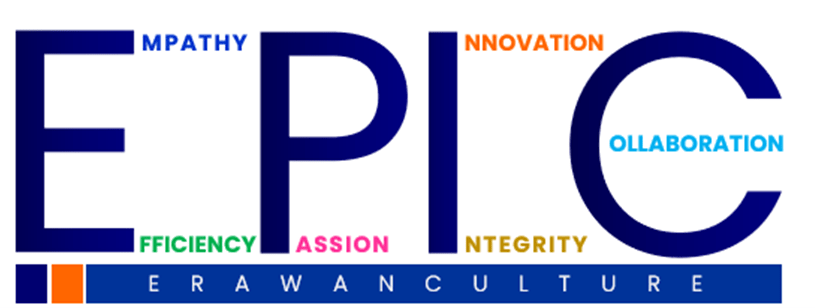
The organization’s innovation vision is integrated into its “Corporate Culture of Sustainability,” known as “EPIC,” which comprises:
E = Empathy & Efficiency
P = Passion
I = Innovation & Integrity
C = Collaboration
Smart Guest Room Control: An Innovation for Sustainable and Intelligent Stays
The Company is committed to continuously enhancing the guest experience through innovative technology. In collaboration with BanpuNext, the "Smart Guest Room Control" initiative was launched, integrating motion detection with in-room temperature monitoring. This smart system optimizes energy usage without compromising guest comfort.
Following the installation of the “SensorFlow” system in seven pilot guest rooms, the results showed a significant reduction in energy consumption and operating costs. The Company plans to expand the implementation in 2025 as part of its broader commitment to sustainability and efficient energy management.
| Measurement | Result |
|---|---|
| Monthly energy saving (by calculation) | 44,975 kWh amounting to appx. THB 185,679 |
| Monthly energy saving (by actual consumption) | 47,949 kWh amounting to appx. THB 197,957 |
| Time duration of activated censor (expected) | 4.50 hour/ room/ day |
| Time duration of activated censor (by actual consumption) | 6.29 hour/ room/ day |
Remark Calculated from average of 1 kWh = THB 4.1285
Other business innovations and technology
HOP INN, a budget hotel network under supervision of ERW, has been continually improving its operational cost and efficiency at all aspects while maintaining its service quality and customer satisfaction.
More DetailsHOP Inn's Chatbot booking system is a service that adds more channels for customers to conveniently make reservations. It also supports branch expansion which is increasing every year. The booking via Chatbot grew 2 times compared to 2021, with the Chatbot efficiency the workload of call center is subside and improving the quality of life of employees.
Driving a Greener Future with EV Charging Stations
The Company supports eco-friendly lifestyles by expanding its network of Electric Vehicle (EV) charging stations, providing added convenience for guests and visitors across its hotel portfolio. In 2023, EV charging stations were installed at four Hop Inn hotels in Thailand: Kanchanaburi, Chonburi, Hua Hin, and Chiang Mai. As of 2023, a total of 10 hotels under The Erawan Group offer EV charging facilities underscoring the Company’s commitment to sustainable mobility and the growing shift toward electric vehicles.
In 2025, the Company continued to provide EV charging station services to enhance convenience for hotel guests while promoting the adoption of green energy and sustainable mobility. A total of 17 hotels were equipped with EV charging stations, including:
- Grand Hyatt Erawan Bangkok
- JW Marriott Bangkok
- Courtyard by Marriott Bangkok
- Holiday Inn Pattaya
- Novotel ibis Styles Bangkok Sukhumvit 4
- ibis Bangkok Riverside
- ibis Bangkok Sathorn
- Mercure ibis Bangkok Siam
- Mercure ibis Bangkok Sukhumvit 24
- ibis Bangkok Sukhumvit 4
- ibis Pattaya
- ibis Phuket Patong
- Mercure Pattaya Ocean Resort
- HOP INN Hua Hin
- HOP INN Kanchanaburi
- HOP INN Chonburi
- HOP INN Chiang Mai
We currently operate 20 electric vehicle (EV) charging stations and have plans to expand the installation of additional service points in the coming year.
Digital Transformation and Cyber Security
The Company and its affiliates have established policies and guidelines to safeguard the security of information systems and data, alongside supportive measures for business continuity in the event of an emergency:
- Compliance readiness for the Personal Data Protection Act (PDPA) and the Computer Crime Act, through employee training and the deployment of software to protect corporate data and the data of relevant stakeholders.
- Ongoing study and adoption of tools and methods to manage, monitor, and analyze cybersecurity systems.
- Regular phishing-simulation testing to build employee awareness of safe email practices.
- Continuous employee education on threats across email, intranet, and social media, using real-world cybersecurity cases to reduce potential risk.
- A five-year information technology plan to support the Company's change and growth.
- Optimization of the operating environment to support Active Directory and security through Azure AD.
- Continuously Strengthening Information Security Systems
- Ensure the integrity, confidentiality, and protection of data through appropriate information security controls and safeguards.
- Continuously monitor, detect, and respond to information security threats and incidents to minimize potential risks and impacts.
- Define clear information security responsibilities and accountability across the workforce and promote employee awareness of information security practices.
- Establish information security requirements for third parties, including suppliers and business partners, and monitor compliance with applicable security standards.
- Regularly review and enhance information security systems and controls to address emerging threats, technological developments, and evolving business risks.
Information Security Management (ISO/IEC 27001)
The Company has established an Information Security Management System (ISMS) aligned with the ISO/IEC 27001:2022 international standard to protect the confidentiality, integrity, and availability of its information assets. The ISMS is built on a Plan-Do-Check-Act (PDCA) model and is overseen by a dedicated governance structure comprising an ISMS management committee, a management representative, a working committee, and internal auditors.
Key elements of the Company's information security management include:
- A defined ISMS scope covering IT services, network infrastructure, and supporting facilities, with clearly identified interfaces and dependencies.
- An information security risk management process aligned with ISO/IEC 27005, applying risk assessment and treatment through avoidance, acceptance, mitigation, or transfer.
- Regular internal audits and at least annual management reviews to drive continual improvement.
- Annual information security awareness training for personnel.
- Business continuity and disaster recovery arrangements, including multi-region cloud infrastructure and a disaster recovery site, complemented by cyber insurance.
- Ensure the integrity, confidentiality, and protection of data.
- Monitor, detect, and respond promptly to information security threats and incidents.
- Define clear individual responsibilities and accountability for information security across the entire workforce.
- Establish and communicate information security requirements for third parties, including suppliers and business partners.
- Escalation process for employees to report incidents, vulnerabilities or suspicious activities
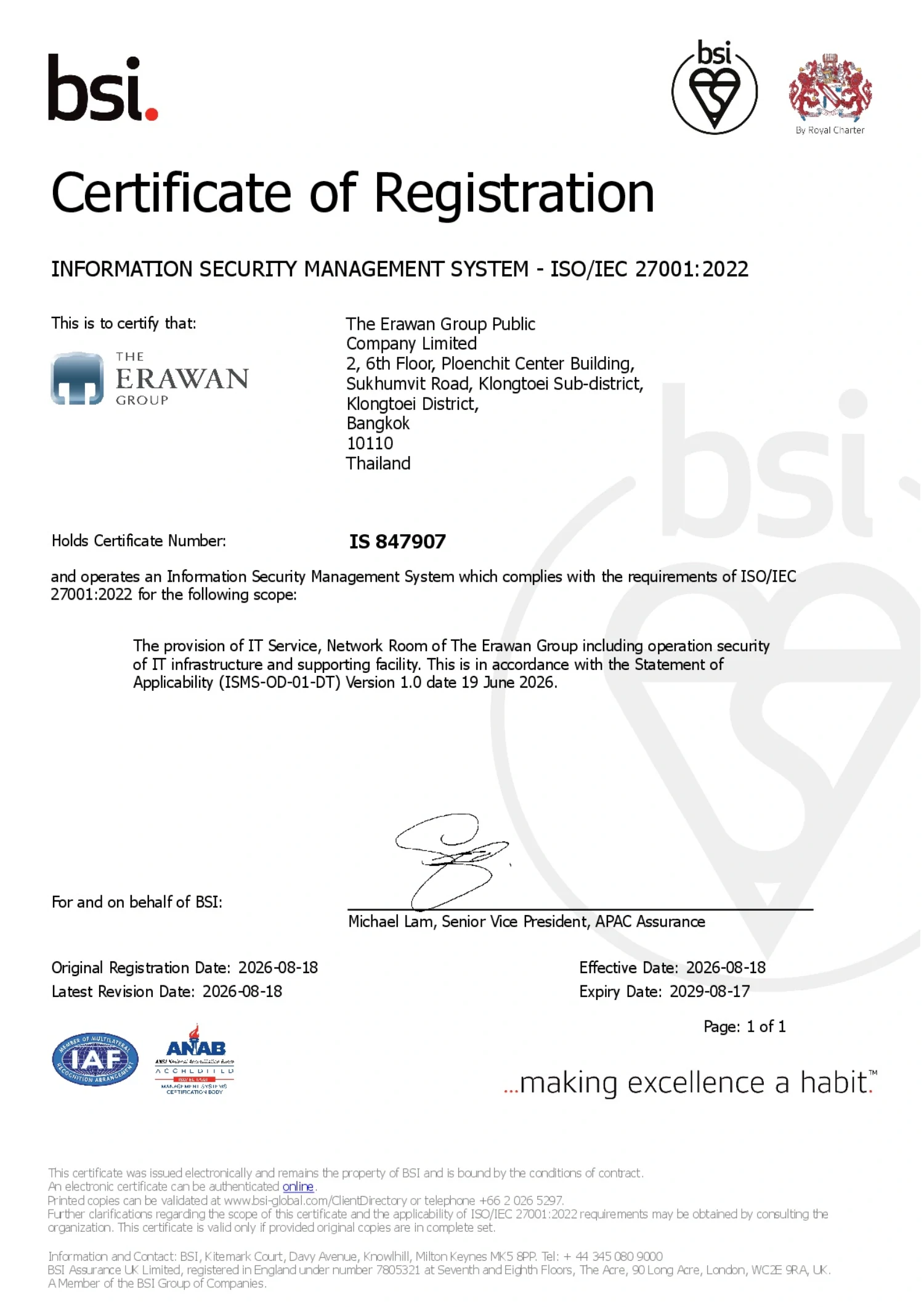
In 2026, the Company achieved ISO/IEC 27001:2022 certification (Certificate No. IS 847907), issued by BSI (British Standards Institution), following successful Stage 1 and Stage 2 assessments with no nonconformities. The certification is valid from 18 August 2026 to 17 August 2029 and covers the provision of IT services and the network room at the Company's head office, including the operational security of IT infrastructure and supporting facilities. Certification forms part of the Company's ongoing information security roadmap.
Responsible AI Governance
The Erawan Group is committed to adopting Artificial Intelligence (AI) in a responsible, ethical, secure, and human-centric manner. As AI becomes integral to enhancing operational efficiency, guest experience, and decision-making, the Company governs both the development and use of AI to capture its opportunities while managing its risks including data privacy, security, bias, and ethical considerations.
Governance structure
In 2026, the Company established an "AI Governance Committee" to oversee, direct, and control AI initiatives across the organization, ensuring alignment with the Company's strategic objectives, its AI Governance Principles, and applicable legal and regulatory requirements. The Committee defines clear roles, responsibilities, and authority for the oversight of AI development, procurement, deployment, and usage.
AI Governance Policy
The Company's AI Governance Policy, approved and effective 1 June 2026, sets a clear framework for the responsible design, development, and deployment of AI across the Group. It is built on seven governance principles:
- Reliability and Fitness for Purpose : AI systems are designed, developed, and operated to perform consistently and accurately for their intended business purpose, with continuous monitoring and performance evaluation.
- Ethics and Legal Compliance: AI is developed and used in line with the Company's ethics, values, and business standards, and in strict compliance with applicable laws and regulations in every jurisdiction in which the Company operates.
- Security by Design: AI systems are designed and deployed with system integrity and resilience in mind, with safeguards against misuse, data tampering, and unauthorized access.
- Transparency and Accountability: AI use is transparent and auditable, operating under appropriate governance with clearly assigned roles, responsibilities, and accountability for outcomes and impacts.
- Privacy and Data Protection: AI respects and protects personal data and the privacy rights of stakeholders, in strict alignment with the Company's privacy policy and applicable data protection law.
- Fairness and Non-Discrimination: AI is designed and used with fairness and equity in mind, mitigating bias to avoid outcomes that could unfairly affect any individual or group.
- Human Oversight: The level and form of human oversight is proportionate to the risk and impact of each AI use case, applying human-in-the-loop, human-over-the-loop, or human-out-of-the-loop approaches as appropriate.
Responsible Artificial Intelligence Program
The Company applies a tiered framework for acceptable AI use that governs what data may be used with which category of AI tool, protecting confidential information, personal data (PDPA), and commercially sensitive material. Employees receive Responsible AI awareness training to embed safe and responsible practices in day-to-day work. AI provided by external service providers is governed under the same principles and subject to appropriate contractual and risk controls.
- Restrict access to sensitive AI capabilities, such as facial recognition and surveillance technologies, based on defined authorization and governance requirements.
- Clearly label AI-generated content and disclose when outcomes or decisions are supported or generated by AI.
- Establish mechanisms to monitor and detect model drift, degradation, or performance issues over time and take appropriate corrective actions.
- Conduct regular assessments of deployed AI models to identify and address potential bias and ensure fairness.
- Implement initiatives, independently or in collaboration with suppliers, to reduce the environmental footprint of AI models and data centres.
- Establish an appeals and review process that enables users and affected third parties to challenge or seek reconsideration of AI-driven decisions or outcomes.
- Measure and quantify the sustainability impacts and outcomes generated by AI initiatives and tools.
- Provide employees with training on the ethical, responsible, and secure use of AI.
Lifecycle governance
AI is managed across its lifecycle from defining requirements, to using approved tools, to assessing risk, to responsible deployment, to monitoring outcomes ensuring AI remains reliable, secure, and aligned with the Company's objectives over time.